
Many people assume a French pedicure is just the white-tip look from a French manicure, scaled down to the toes. It’s close, but toenails have their own quirks that make a French pedicure behave differently from a French manicure, and most of those quirks are exactly why people get the proportions wrong trying it at home.
What a french pedicure actually is
A French pedicure is the same basic idea as a French manicure: a sheer, pale pink or nude base with a crisp white line painted across the tip of the nail. On toenails, though, the tip line usually needs to be shorter and straighter than on fingernails, since toenails are wider relative to their length and a deep curve that looks elegant on a finger can look clownish on a toe. Most techs paint the white tip in a flatter, more horizontal line for this reason, sometimes barely curved at all.
The base color matters more here too. Toenails tend to show less of the nail bed through the polish than fingernails do, so a true French pedicure often leans on a slightly opaque pink-beige rather than the sheer, almost-invisible base used on hands. That small difference in opacity is part of why a French pedicure can look chalky or flat if the base shade is copied directly from a French manicure kit instead of chosen for toes specifically.
Gel versus regular polish for the white tip
Regular polish is more forgiving for a first attempt, since mistakes wipe off cleanly with a cotton swab and remover before they cure. Gel polish holds a sharper, more durable line once it’s cured, but there’s no undoing a shaky stroke once it’s under the lamp without removing and restarting that nail. A lot of techs build the white tip in gel using a detail brush and a striping gel specifically made to hold a thin, controlled edge, rather than a standard gel polish bottle brush, which tends to be too wide for toenails especially.
Durability-wise, gel holds up noticeably longer on toes than on fingers simply because toenails grow slower. A gel French pedicure can realistically go a month or more before the tip line starts looking dated, well past where a regular polish version would already need a touch-up, similar to how a shellac service on fingernails outlasts standard polish for the same basic reason.
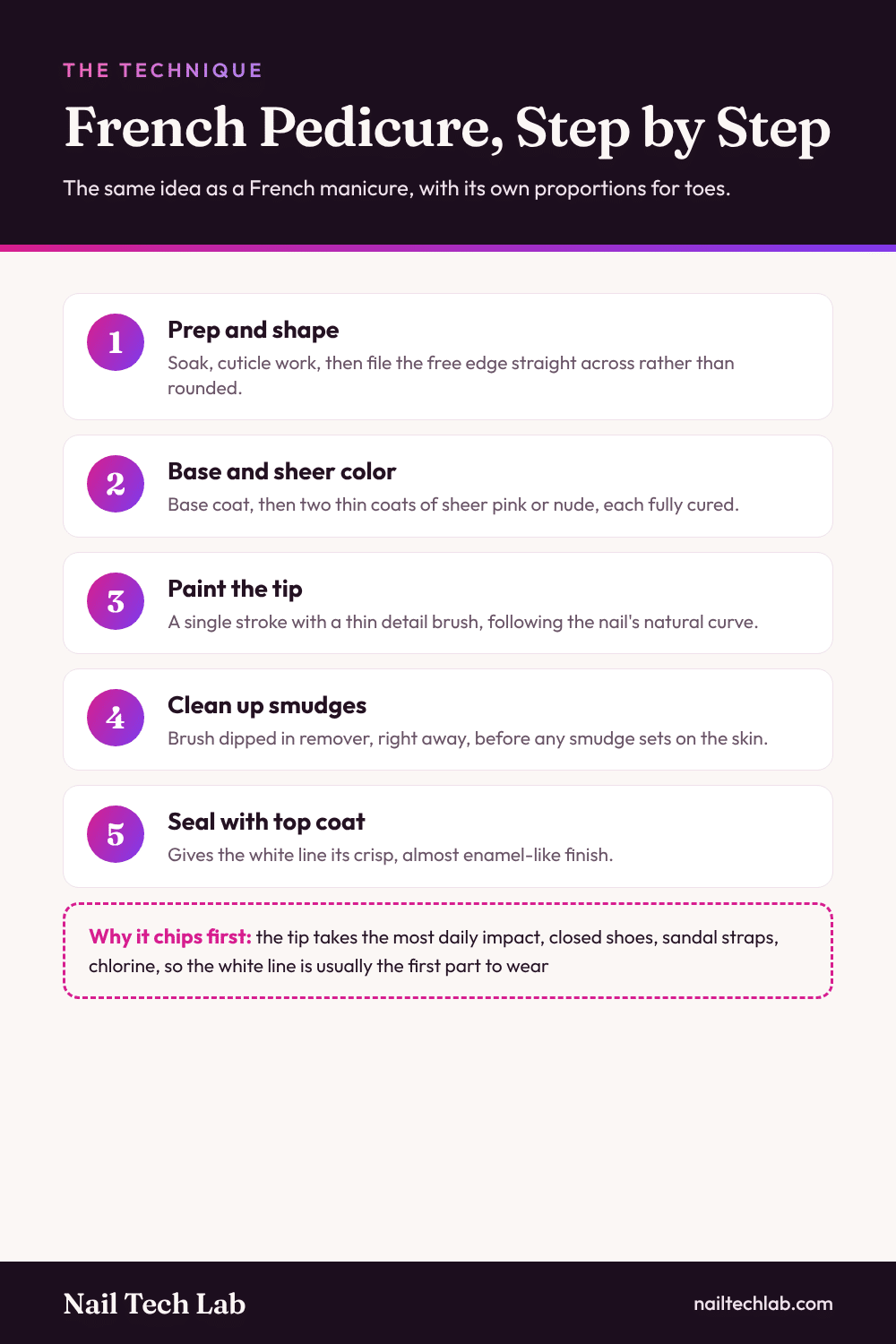
The actual technique, step by step
Start with the usual pedicure prep: soak, cuticle work (our guide to why cuticle oil matters covers why this step gets rushed more often than it should), filing and shaping the free edge straight across rather than rounded, since a straight edge gives the white tip a cleaner line to follow. Apply a base coat, then the sheer pink or nude color in two thin coats, letting each one dry or cure fully.
For the tip, dip a thin detail brush or use the narrow brush that comes with a striping polish, and paint a single stroke from one corner of the free edge to the other, following the natural curve of the nail’s tip rather than forcing a curve that isn’t there. Clean up any smudges along the skin immediately with a brush dipped in remover before they set, since toenails sit close enough together that smudging onto a neighboring toe happens more easily than on fingers. Seal the whole thing with a glossy top coat, which is also what gives the white line its crisp, almost enamel-like finish rather than a flat, chalky look.
Why french pedicures chip differently than regular polish
The tip of a nail takes more daily impact than the rest of the nail plate, especially on toes jammed into closed shoes or sandals rubbing against straps all day. That means the white line is usually the first part of a French pedicure to show wear, chipping or yellowing slightly at the very edge while the rest of the color still looks fresh. Swapping to open sandals when the weather allows, and avoiding tight closed-toe shoes for the first day or two after the service, cuts down on this noticeably.
Pool time and chlorine are harder on the white tip than on solid color too, since chlorine can leave a faint yellow cast on white polish specifically. If pool season is the whole reason for wanting a French pedicure in the first place, gel holds that white tone better than regular polish does, though neither is fully immune to a slight tint showing up after repeated exposure.
Picking the right white for your skin tone
Not every white reads the same against every skin tone. A stark, blue-based white can look harsh against very fair skin, while a warmer, slightly creamy white often blends more naturally. Against deeper skin tones, a bright true white tends to pop more and read as more deliberate rather than washed out. It’s worth asking your tech to swatch two or three white options directly on your toe before committing, since white polish can look different in the bottle than it does against your actual skin.
Frequently asked questions
How long does a french pedicure last?
Regular polish typically holds two to three weeks before the tip starts chipping. A gel version can last four to six weeks, since toenails grow more slowly and gel resists the daily impact at the free edge better than regular polish does.
Can I do a french pedicure at home without gel?
Yes, though it takes a steadier hand without the forgiveness of gel’s slower cure time. A thin striping brush, a straight-cut free edge, and a few practice strokes on paper first before touching the actual nail all make a real difference.
Why does my white tip look yellow after a few weeks?
White polish, gel or regular, tends to pick up a faint yellow cast from chlorine, certain soaps, and UV exposure over time. It’s not usually a sign of poor application, just a normal property of white pigment that shows up more visibly than it would on a darker shade.
Is a french pedicure more expensive than a regular one?
Most salons charge a small add-on fee, often five to ten dollars, since the tip work takes extra time compared to a single solid color. Gel versions cost more on top of that, the same as any gel pedicure upgrade would.
What shape of nail works best for a french pedicure?
A straight, slightly squared free edge gives the cleanest line for the white tip. Very rounded or short toenails make it harder to paint a crisp edge, since there’s less flat surface at the tip to work with.