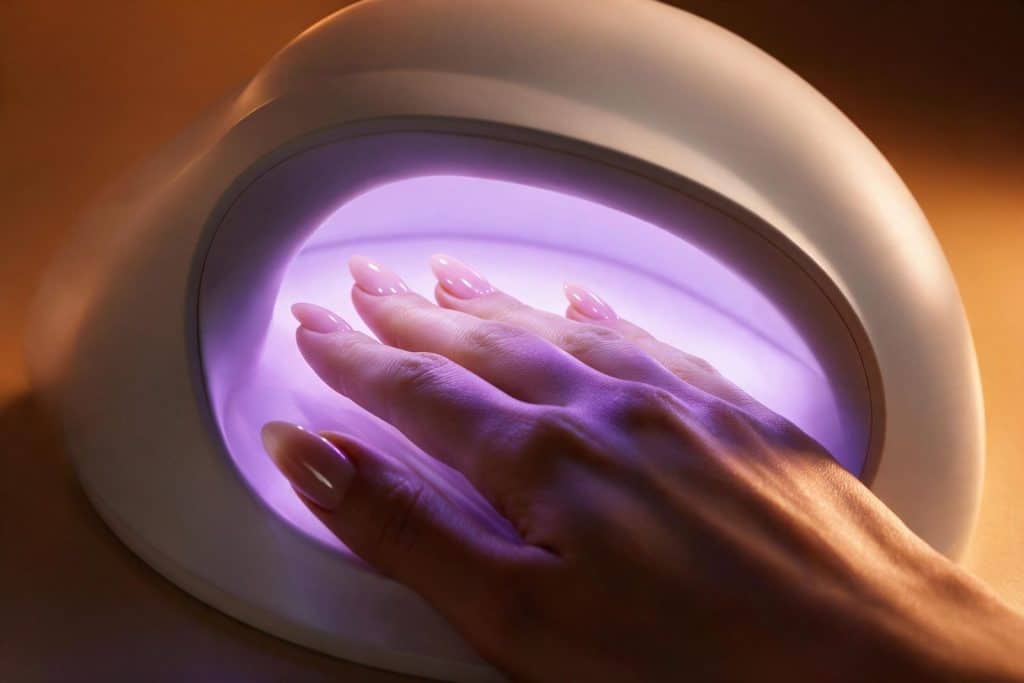
A tech messages me a photo of her hand: builder gel that’s been under a 48W lamp for the full cure time, still soft enough to dent with a fingernail. Her first guess is bad product. Her actual lamp, bought two years ago for gel polish top coats, has never once been asked to push light through a 2mm apex of builder gel before. That’s the gap this guide is for. The pillar on choosing a UV nail lamp covers the general specs. This one is about the narrower question people actually search: what does a lamp need to do specifically for builder gel, and how do you tell before buying whether it will hold up.
Why builder gel is harder on a lamp than gel polish
A coat of gel polish is thin and even, maybe 0.3mm across the whole nail. Light reaches every photoinitiator molecule in it without much trouble. Builder gel isn’t applied that way. It’s built up in an apex, thicker at the stress point and tapering toward the edges, often 1.5 to 2mm at its peak once two or three layers are stacked. Light has to pass all the way through that thickness to cure the bottom layer against the nail plate, not just skin over the top.
This is why a lamp that cures gel polish perfectly well can still leave builder gel soft underneath a surface that looks and feels done. The top few tenths of a millimeter get enough light and harden. The base, closest to the nail, sits in shadow relative to the surface and can stay partially uncured even after the full time on the timer. That soft base is where lifting starts a few days later, and it’s rarely obvious at the time of application because the top layer feels solid under a thumbnail press.
The specs that actually matter for builder gel
Wattage and diode density
For gel polish, 24W to 48W is fine. For builder gel, you want 48W to 72W, and the number alone isn’t the whole story. Two lamps rated at the same wattage can perform differently depending on how many diodes are packed in and how they’re arranged around the hand. A lamp with diodes clustered mostly overhead and thin coverage at the sides will undercure the edges of a thick apex even at a respectable wattage. Look for lamps that specifically list diode count (72, 84, or more LEDs is common in lamps built for professional use) rather than wattage alone.
UV/LED hybrid, not one or the other
Builder gel formulas vary in which wavelength they’re built around. Most current LED-cure builder gels respond to light around 405nm, but plenty of hybrid and older formulas still need broader UVA coverage to cure fully, especially at the base of a thick apex where less light penetrates. A hybrid lamp that combines LED diodes with CCFL tubes, or LED diodes spanning a wider band, removes the guesswork. If you only ever use one brand’s builder gel and know its exact cure spec, a dedicated LED lamp matched to that spec works too, but hybrid is the safer default for anyone switching between brands.
Mitt-style housing over finger slots
This matters more for builder gel than for gel polish, because an apex that’s undercured on one side is a bigger structural problem than a polish edge that’s slightly soft. Finger-slot lamps cure well when a finger sits dead center, but the thumb rarely fits the slot as cleanly as the other four digits, and an angled thumb gets less direct light on one side of the apex. Mitt-style lamps surround the whole hand at once and cure more evenly across all five nails, thumb included. For anyone doing full sets regularly, this is worth the extra size on the counter.
Timer presets that match the label, not just convenience
Builder gel manufacturers spec cure times per layer, usually 60 to 90 seconds under LED and 2 to 3 minutes under UV. A lamp with only a 30-second preset forces either double-tapping the button mid-application or eyeballing the time, both of which introduce the kind of inconsistency that leads to a soft apex base. Check that the preset options actually cover the range builder gel needs before assuming any lamp with a timer will do.
What “holds up under daily use” actually means
A lamp that cures builder gel fine out of the box can still fail six months into daily use, and the failure is usually gradual rather than sudden. CCFL tubes in UV and hybrid lamps lose output over months, so a lamp that cured a full apex in 90 seconds in January might need 120 seconds by summer without anyone noticing the drift, since it happens a few seconds at a time. LED diodes hold their output much longer, which is part of why LED-heavy hybrids tend to be the more reliable pick for anyone doing builder gel several times a week.
Heat is the other durability factor specific to builder gel. A thick apex under a strong lamp produces a sharper heat spike than a thin coat of polish, because more photoinitiator is reacting across more material at once. Lamps with poor heat dissipation, usually cheaper units with tightly packed diodes and no venting, can get uncomfortably hot on back-to-back clients and sometimes throttle their own output as a protective measure, which then undercures the next set without warning. A lamp that stays warm but not scorching after repeated use, with some ventilation in the housing, tends to hold its cure quality longer.
Budget, mid-range, or professional-grade
For occasional builder gel at home, a $40 to $60 hybrid lamp with at least 48W and a mitt-style opening covers the basics. For anyone doing sets on clients or working through builder gel weekly, the $70 to $120 range is where reflector quality, diode arrangement, and thumb coverage stop being a gamble. Above that, the jump to $150 and up mostly buys faster cure times and sturdier housing for salon volume rather than a meaningfully different cure quality, so it’s not necessary for most home or part-time use.
Signs a lamp won’t hold up for builder gel
A few things tend to show up together on lamps that struggle with builder gel specifically, even when they cure gel polish without complaint. Finger-slot design with no mitt option. A single preset under 60 seconds with no way to extend it. LED-only with no UV coverage and no published wavelength range. Plastic housing that flexes when you press on it, which usually means thin diode spacing underneath. And reviews mentioning gel polish working fine while thicker product, builder gel or acrylic dip, comes out soft. Any one of these alone isn’t disqualifying, but two or three together are a reasonable signal to keep looking.
The short version
If the goal is a UV lamp for builder gel specifically rather than gel polish in general, three things matter more than the rest: enough wattage and diode coverage to reach 48W to 72W with even spread across all five fingers, a hybrid UV/LED setup so cure isn’t dependent on matching one exact formula, and timer presets that actually reach the 60 to 90 second range builder gel needs per layer. A mitt-style housing solves the thumb coverage problem that finger slots create. Everything past that, extra presets, app connectivity, color options, is preference rather than something that affects whether the apex fully cures.
Frequently asked questions
What wattage lamp do I need for builder gel?
48W to 72W LED covers most builder gel formulas. Lower wattage lamps can still cure builder gel, but usually need longer than the product label specifies, which raises the risk of an undercured apex base.
Can I use a gel polish lamp for builder gel?
Sometimes, but not reliably. A lamp built for thin polish coats often lacks the wattage and even coverage a thick builder gel apex needs, especially near the thumb and at the base of the apex closest to the nail.
Is UV or LED better for builder gel?
Neither is universally better; it depends on the formula. A UV/LED hybrid lamp removes the guesswork, since it covers the wavelength range most builder gel brands are formulated around instead of betting on one.
Why does my builder gel still feel tacky after curing?
Usually the apex was too thick for the cure time used, the lamp’s tubes or diodes have lost output with age, or the preset time didn’t match what the product label specifies. A sticky dispersion layer that wipes off with alcohol is normal; a soft or dented layer underneath is not.
Do I need a mitt-style lamp for builder gel?
It’s not required, but it solves the most common coverage problem, which is the thumb curing less evenly than the other four fingers in a finger-slot lamp. For anyone doing full sets regularly, a mitt is worth the extra counter space.
How often should I replace my UV lamp bulbs?
CCFL tubes in UV and hybrid lamps typically need replacing every 6 to 12 months with regular use, since output drops gradually before a tube fully fails. LED diodes are rated for tens of thousands of hours and rarely need replacement within the lamp’s working life.
Can a lamp be too powerful for builder gel?
Within the normal 48W to 72W range for builder gel, no. Very high-output lamps mostly just cure faster rather than causing problems, though a sharper heat spike is more noticeable on thick, dark-pigmented apex layers regardless of lamp strength.