A client asked me this exact question two weeks before her honeymoon: dip powder or gel, which one is actually going to survive ten days of swimming, sunscreen, and airport everything? I had to stop her and ask which gel she meant, because dip powder vs gel is really two different comparisons wearing one question, and the honest answer changes depending on which one she was picturing.
The short answer
Dip powder tends to outlast gel polish, usually by a week or so, but holds up about the same as builder gel when both are applied and maintained well. Against acrylic, dip powder is a close second for durability but loses on raw strength for long extensions. None of that matters as much as prep and aftercare, which is where most early failures actually come from regardless of which product you pick.
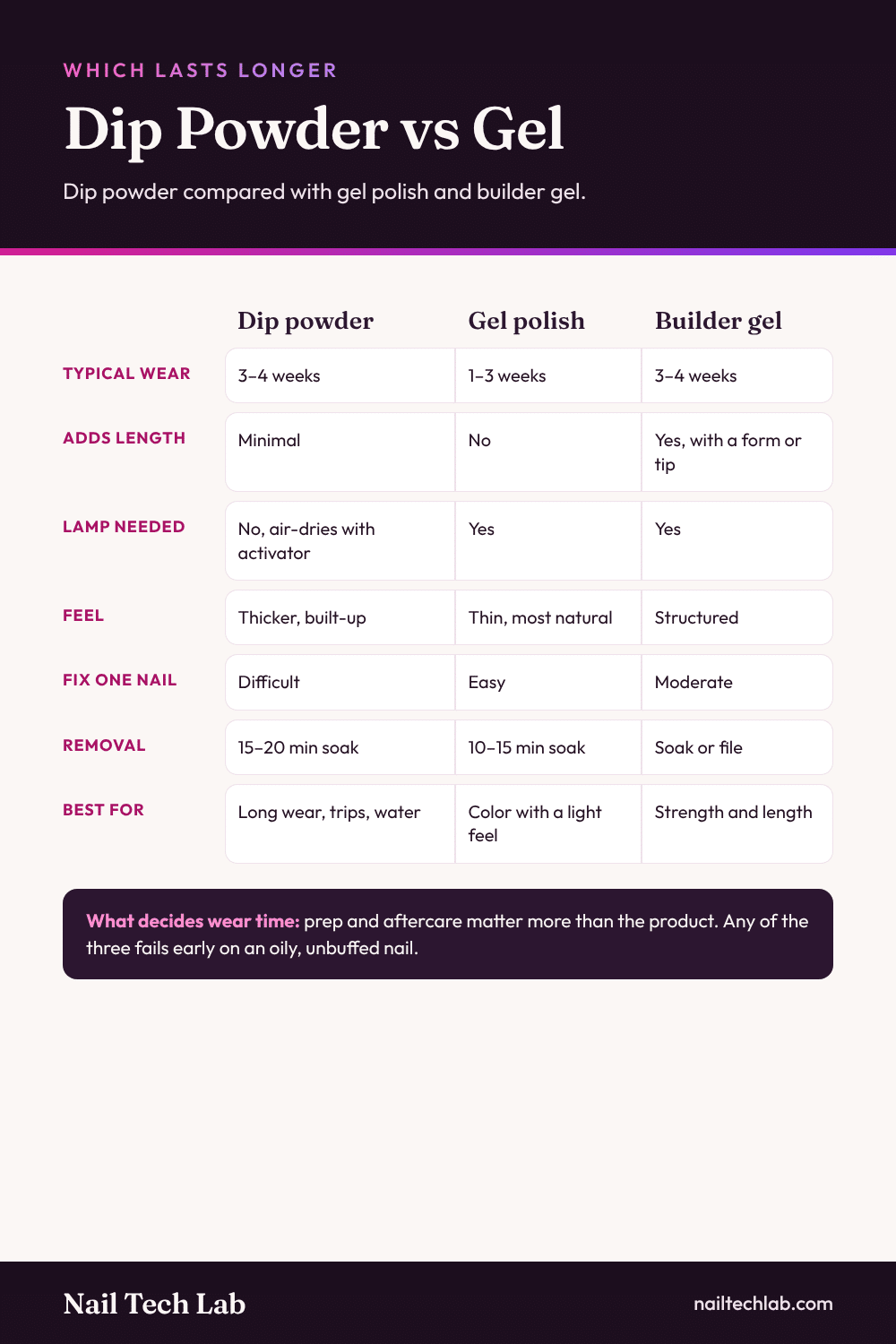
| Dip powder | Gel polish | Builder gel | Acrylic | |
|---|---|---|---|---|
| Typical wear | 3-4 weeks | 1-3 weeks | 3-4 weeks | 3-4 weeks |
| Adds structure/length | Minimal | No | Yes | Yes |
| Odor during application | Low | Low | Low | Strong |
| Repairable single nail | Difficult | Easy | Moderate | Easy |
| Removal time | 15-20 min soak | 10-15 min soak | Soak or file | File or soak |
Dip powder vs gel polish
This is the more common comparison, and it isn’t close. Dip powder typically lasts three to four weeks before it needs a fill or full removal, while gel polish averages one to three weeks before chipping or lifting becomes noticeable. The gap comes down to what each product actually is. Gel polish is a thin color coating with essentially no structural layer. Dip powder builds up in multiple dipped and sealed layers, giving it more physical bulk and, with it, more resistance to chipping at the free edge, which is usually where color coatings fail first.
Gel polish wins on a couple of other fronts, though. It’s thinner and more flexible against the nail, so it tends to look and feel more natural, and removal is faster, ten to fifteen minutes of soaking versus dip powder’s longer soak-off time given the extra layers. If durability is the only priority, dip powder is the better bet. If a thin, natural, quick-to-remove color layer matters more, gel polish still has a place.
Dip powder vs builder gel
When people say “gel” and mean builder gel rather than gel polish, the comparison shifts. Both are applied thicker than gel polish and both hold up in the three-to-four-week range, so durability lands close to a tie in practice. The real difference is what each product is built to do. Builder gel is a structural product first, made to add strength and, with a form or tip, real length. Dip powder is closer to a heavily built-up color coating: durable, but not designed the same way to bear the load of a long extension the way builder gel is.
For someone who wants their natural nails reinforced with some added durability and doesn’t need length, either works. For anyone wanting actual extensions, builder gel is the more purpose-built choice.
Dip powder vs acrylic
Acrylic still edges out dip powder on raw strength and repairability. A single cracked acrylic nail can be patched with more liquid-and-powder and blended in without redoing the whole set, which is harder to do cleanly with dip powder once a layer has cured. For long, load-bearing extensions, especially on someone hard on their hands, acrylic remains the more durable option overall.
Where dip powder pulls ahead is finish and process. It has little to no odor compared to acrylic’s liquid monomer smell, no lamp is needed since it air-dries with an activator, and the finished look tends to be glossier and less prone to the yellowing some acrylics develop over time. Durability-wise the two are close, both commonly reach three to four weeks, but acrylic has more of a track record for holding up under real physical stress like heavy hand use, gardening, or manual work.
For a deeper dive into fills, removal, and cost specifically between these two systems, see our full dip powder vs acrylic nails comparison.
Which one for a trip or special occasion
For the honeymoon question that started this: dip powder was the right call for her specifically, since the trip meant heavy water and sunscreen exposure and no easy access to a salon for a mid-trip repair. Dip powder’s extra bulk holds up well against that kind of exposure, and its slightly longer average wear time meant she wouldn’t need a fill while traveling. If the trip had involved more hands-on physical activity, hiking, manual work, anything likely to actually crack a nail rather than just wear color down, acrylic would have been the safer recommendation for the same reason it wins on repairability day to day.
Which is easier to do yourself at home
Dip powder has become the more popular DIY choice of the two gel comparisons, mostly because the process doesn’t need a lamp: base coat, dip, activator, repeat, done. Gel polish and builder gel both require a UV or LED lamp to cure each layer, which means an upfront equipment cost that dip powder skips entirely. That said, dip powder’s dipping motion takes some practice to keep clean and even, and a first attempt often ends up thicker or messier at the cuticle line than a first attempt with gel polish, which just gets brushed on. Neither is genuinely hard to learn. Dip powder just trades lamp dependency for a slightly different, and for some people less intuitive, application motion.
What actually determines how long any of them last
Prep matters more than the product choice itself. A nail plate that wasn’t properly dehydrated and buffed before application will fail early no matter what goes on top of it, dip powder, gel polish, builder gel, or acrylic. Application skill is the second variable techs see most often: uneven sealing on dip powder, undercured layers on any gel system, or an acrylic bead applied too thick near the cuticle all shorten wear regardless of which product family it belongs to. Aftercare, gloves for dishes and cleaning, cuticle oil, avoiding using nails as tools, adds real weeks to any of these systems and subtracts them just as fast when skipped.
Removal is where the two differ most in practice: dip needs a longer acetone soak than gel polish. If you’re about to take a dip set off, our guide on removing dip powder nails walks through it step by step.
Frequently asked questions
Does dip powder really last longer than gel? Longer than gel polish, typically by about a week. Compared to builder gel, wear time is close to even when both are applied and maintained well.
Is dip powder better than acrylic for durability? Acrylic still holds up better for long extensions and heavy hand use, since it’s easier to repair and generally stronger under physical stress. Dip powder comes close for shorter, natural-length wear.
Which is healthier for your nails, dip powder or gel? Neither damages nails inherently when applied and removed correctly. Most damage attributed to either product actually comes from picking or peeling it off instead of soaking it away properly.
Can you switch between dip powder and gel without damaging your nails? Yes, as long as each is fully removed with proper soak-off before the next application, rather than filed down aggressively or layered over old product.
Which is cheaper over time, dip powder or gel? Costs vary by salon, but dip powder’s longer average wear time between fills can mean fewer appointments per month compared to gel polish, which often needs more frequent touch-ups.
Is dip powder or gel better for a beach vacation? Dip powder generally holds up better against heavy water and sunscreen exposure over a trip, since its added bulk resists chipping better than a thin gel polish coating.