
A starter bit kit shows up with ten or twelve metal shapes lined up in a case, and beyond a printed card that gets lost by the second use, nothing tells you which one does what. Most new e-file owners grab whichever bit looks closest to the right size, run it at whatever speed feels reasonable, and learn the rest on a real nail through trial and error. That’s how a lot of the damage stories in the nail drill buyer’s guide actually start: not a bad machine, but the wrong bit asked to do a job it wasn’t built for.
Nail drill bits aren’t interchangeable the way a bulk kit makes them look. Shape decides what a bit does to the nail surface, material decides how aggressively it cuts, and grit decides how much comes off with each pass. Get any one of those wrong and even a good drill run at a careful speed can gouge, overheat, or just fail to finish the job it was set to do.
What the shape of a bit actually does
A barrel bit has straight, flat sides and is the workhorse for shortening length and reducing thickness across a flat or gently curved nail surface. It’s usually the first bit reached for when a set needs to come down in bulk before finer work starts.
A cone or tapered bit narrows toward the tip, which lets it follow the natural curve where the nail meets the cuticle. That makes it useful for shaping the edges of an acrylic or gel set and for light cuticle work, without the flat sides of a barrel bit catching on a curved surface.
A flame bit comes to a rounded point and is built to get into the cuticle pocket and along the sidewalls, spaces a wider bit can’t reach cleanly. A ball or bud bit is the rounded opposite of a flame bit, used for cuticle exfoliation, softening callus, and clearing dead skin rather than cutting into product.
A needle or tapered-point bit is the detail tool, thin enough for sidewall channels and drilling charm holes without touching the surrounding nail. A safety bit looks like a barrel or cone but has a smooth, rounded top with no cutting edge at the very tip, which means it can run right up against skin without the risk of digging in the way a standard bit will if the hand slips.
Carbide, diamond, ceramic, and sanding bands
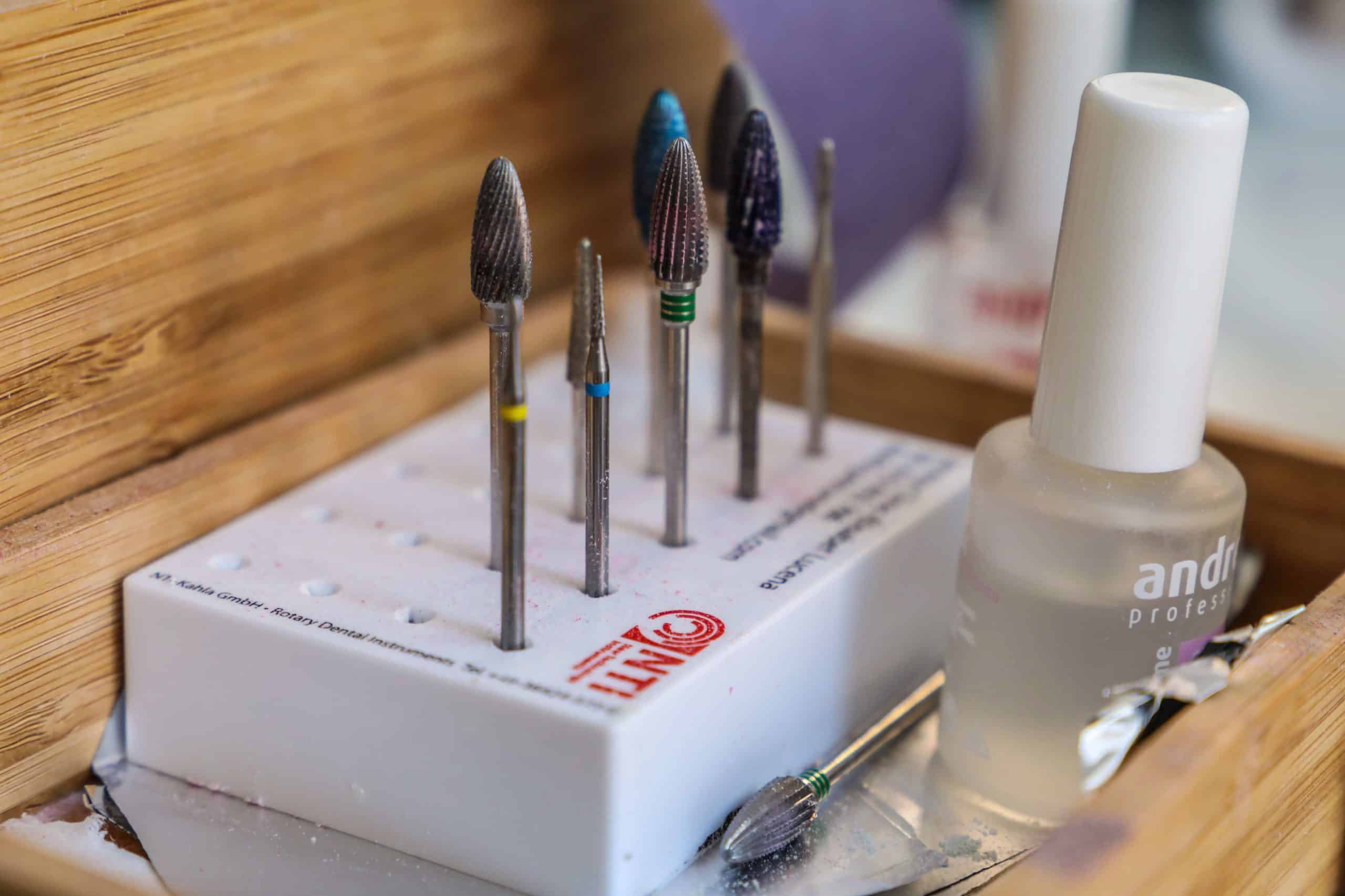
Carbide bits are metal with fine cross-cut flutes and are the fastest option for removing hard product like acrylic or hard gel. They’re not meant to run directly on bare natural nail, where that same aggressive cutting action removes healthy nail plate just as efficiently as it removes product.
Diamond bits are coated in bonded diamond grit rather than cut flutes, which gives a gentler, more controlled abrasive action. That makes them the usual pick for cuticle work and for anything running close to or on the natural nail, at the cost of being slower at bulk product removal than carbide.
Ceramic bits are a newer option that cut in a similar range to carbide but tend to run cooler, which some techs prefer for reducing heat buildup during longer removal sessions. Sanding bands, sometimes called sanding sleeves, are disposable abrasive sheaths that slide onto a mandrel bit rather than a bit in their own right. They’re built for one client and thrown away, which is exactly why they’re common for quick shine removal and general buffing where full disinfection of a metal bit isn’t worth the time for that step.
Grit and the color chart that isn’t quite universal
Grit describes how coarse the abrasive surface of a bit is. Finer grit means smaller cutting particles, a gentler action, and less material removed per pass. Coarser grit removes more material faster, which is useful for bulk product but risky on anything you don’t want to take much off of.
Most professional nail drill bits use a rough color convention to signal grit at a glance: yellow for extra fine, used on skin and natural nail buffing; red for fine, used on natural nails and light gel polish work; blue for medium, the standard for general gel removal and shaping; green for coarse, used for thick acrylic or hard gel debulking; and black or purple for extra coarse, reserved for heavy acrylic removal and callus work in pedicure use. It’s worth treating that chart as a strong convention rather than a fixed rule. Color coding isn’t standardized across every manufacturer, and a green bit from one brand can cut closer to another brand’s blue. Checking the grit number printed on the bit itself, when there is one, is more reliable than color alone.
Matching a bit to the job in front of you
Cuticle work and dry manicure prep call for a diamond or carbide ball or flame bit in a fine or extra fine grit, run at low speed, with a safety bit as the sensible starting point for anyone still building confidence near skin. The same low-RPM, fine-grit approach is what carries a Russian manicure’s dry cuticle work, which leans on exactly this combination rather than the coarser bits used elsewhere in a service.
Removing acrylic or hard gel is the other end of the spectrum: a carbide barrel or cone bit in medium to coarse grit, run within the drill’s controlled speed range rather than at its ceiling, does the bulk of the work efficiently. Soft, soak-off gel polish needs far less from the drill itself, since acetone does most of the dissolving. A medium or fine bit is usually enough just to break the sealed top coat before soaking, not to grind through the color layers.
Shaping and length reduction on an existing set is a barrel bit job in medium grit, while buffing shine off a natural nail before gel goes on calls for a sanding band or a fine diamond bit, kept light enough that shine disappears without thinning the plate underneath it. Callus work in a pedicure service uses its own set of coarser ball and cone bits, usually kept entirely separate from anything used on hands.
Picking the right bit is half the safety equation; our guide on how to use a nail e-file safely covers the speeds and angles that matter just as much.
Cleaning, disinfecting, and knowing when a bit is done
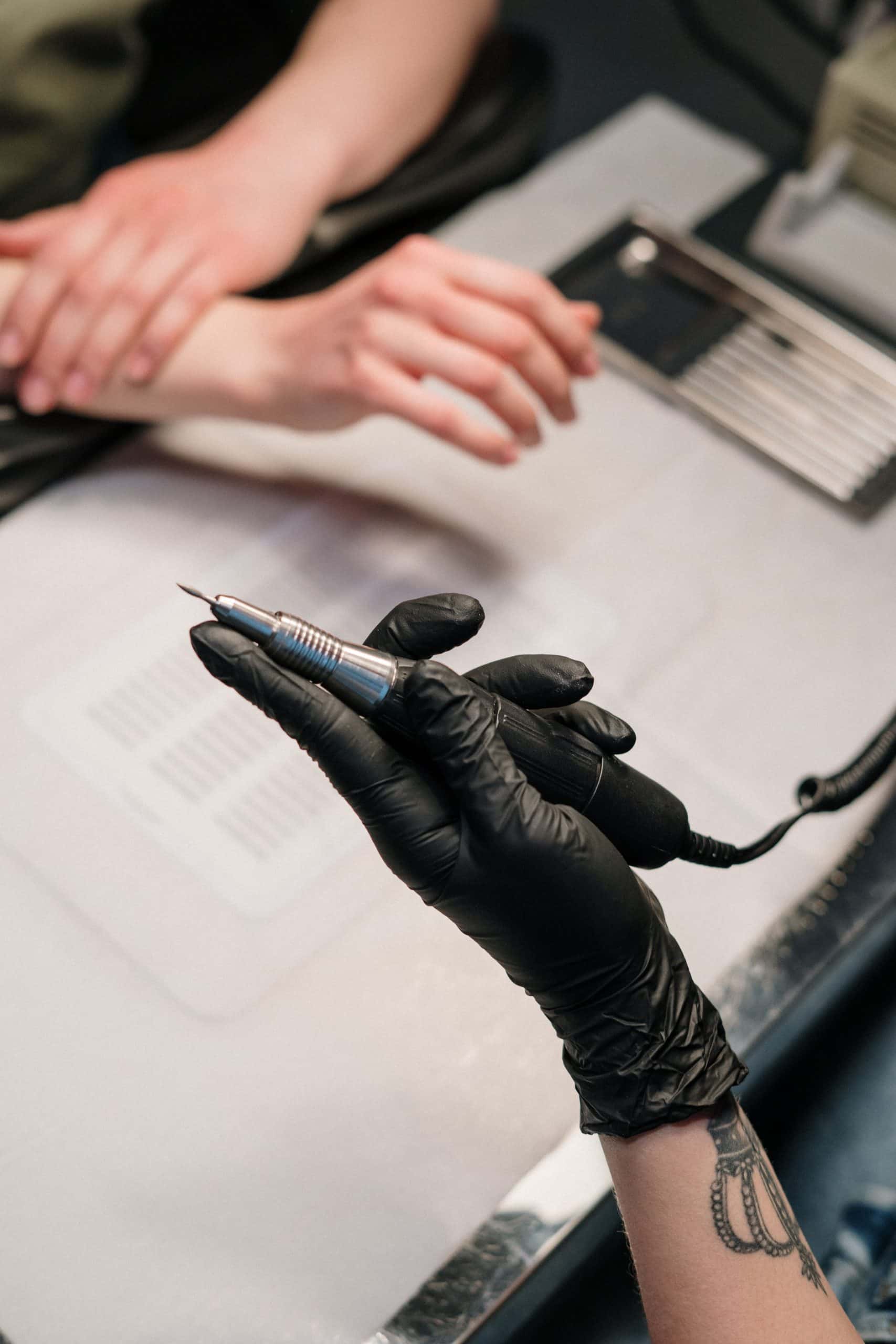
Metal bits, whether carbide, diamond, or ceramic, can be cleaned with a bit brush to clear trapped dust, then disinfected between clients according to whatever standard your local cosmetology board requires for reusable implements. Sanding bands are the exception: they’re single-use by design, cheap enough that reusing one to save a few cents isn’t worth the cross-contamination risk, and they should come off the mandrel and into the trash after every client.
Worn nail drill bits are one of the easiest problems to miss because the loss happens gradually. A bit that’s visibly worn, cutting more slowly than it used to, or running hotter for the same amount of work has lost its edge and is due for retirement rather than another few sets. Pushing a dull bit harder to compensate means more pressure on the nail to get the same result, and pressure is exactly what turns routine buffing into real thinning over time, one of the quieter causes behind gel nails damage that doesn’t trace back to the gel at all. The same problem shows up at the sidewalls specifically: a bit run too aggressively along the edge of the nail is a common backstory behind gel nails lifting soon after a fill, since the seal at that edge is thinner and less forgiving than the flat of the nail. Keeping cuticle oil in regular rotation also helps skin and nail recover faster from the light abrasion of routine drill work.
Frequently asked questions
What is the best nail drill bit for beginners?
A diamond safety bit in a fine or extra fine grit is the standard starting point. The rounded, smooth tip won’t dig into skin the way a standard bit can if the hand slips, which matters more than speed while you’re still learning pressure and angle.
What color grit should I use on natural nails?
Yellow or red, extra fine or fine, is the usual choice for natural nail work. Treat the color as a guide rather than a guarantee, since coding isn’t identical across every brand, and check the grit number on the bit itself when one is printed.
What’s the difference between carbide and diamond nail drill bits?
Carbide bits cut fast and aggressively, which makes them efficient for removing hard product like acrylic but too rough for bare natural nail. Diamond bits use bonded abrasive grit for a gentler, more controlled cut, which is why they’re the usual pick for cuticle work and anything close to the nail plate.
Can sanding bands be reused between clients?
No. Sanding bands are single-use by design and should be discarded after each client rather than disinfected and reused. They’re inexpensive enough that reuse isn’t worth the cross-contamination risk.
Which nail drill bits remove acrylic fastest?
A carbide barrel or cone bit in a medium to coarse grit removes acrylic and hard gel most efficiently. Speed still matters more than grit alone: running within the drill’s controlled range rather than at its top speed keeps the removal fast without losing control.
Do I need separate bits for gel versus acrylic?
Not strictly separate sets, but the grit and material choice should change with the product. Acrylic and hard gel usually call for a coarser carbide bit, while soft gel polish needs only a light pass to break the seal before soaking. As long as bits are properly cleaned and disinfected between uses, the same bit can reasonably serve more than one product type.
How do I know when to replace a nail drill bit?
A bit that cuts more slowly than it used to, or that runs noticeably hotter for the same task, has worn down and should be retired. Continuing to use a dull bit just means pushing harder to get the same result, which raises the risk of overheating or thinning the nail.